In a world where information travels at very high speed, OSINT (Open Source Intelligence) has established itself as a strategic discipline, somewhere between cybersecurity, competitive intelligence and digital investigation. OSINT covers all the data collected lawfully from open sources: forums, social networks, public databases, administrative records, multimedia content and so on.
What is public is not always harmless. OSINT shows that fragments of information can, once cross-referenced, become a genuine goldmine… or a danger.
Used in contexts as varied as journalistic investigation, military operations, cybersecurity and the fight against crime, OSINT is as compelling as it is worrying. Behind its apparent accessibility lie fine-grained skills in extracting, cross-referencing and interpreting data.
Telling raw data apart from strategic intelligence takes method, ethics and, often, professional tools — and of course strict respect for the legal framework.
As things stand, many companies and institutions are realising that they handle, without knowing it, massive quantities of sensitive data exposed to the risk of unauthorised collection.
Where does OSINT data come from, and what can be done with it?
OSINT relies on data accessible without intrusion — that is, publicly available data, free of charge or otherwise. That includes:
- company websites,
- posts on social networks,
- search engines,
- public documents (annual reports, patents, calls for tender),
- leak databases (often illegal, both in how they are assembled and in how they are used).
In 2022, 90% of targeted cyberattacks used data collected through OSINT. (Source: SANS Institute, OSINT 2023 Report)
The purposes are many: identifying human or technical vulnerabilities, monitoring competitors, finding a person, heading off a reputational risk, or documenting an illegal activity.
But this wealth of information can also be a source of threat, particularly for companies. Through OSINT, an attacker can map a structure, identify its executives and its suppliers, and even exploit forgotten information — information that is nonetheless still visible.
The GDPR does not protect data made public by the individual themselves, which creates a legal grey area.
The legality and ethics of OSINT: what you need to know
OSINT is a lawful practice as long as it follows certain rules. In France, it sits within a strict framework.
Here is a non-exhaustive list of the texts that govern OSINT:
- The GDPR
- French Intellectual Property Code: articles 335, 343
- French Criminal Code: article 226, article 311, article 321, article 323
- French Commercial Code: articles L.152-1 to L.152-8
- Court of Cassation:
- Court of Cassation, criminal division, 20 May 2015, no. 14-81.336
- Court of Cassation, criminal division, 8 December 1999, no. 98-84.752
- European regulations:
- REGULATION (EU) 2022/868 OF THE EUROPEAN PARLIAMENT AND OF THE COUNCIL of 30 May 2022 on European data governance and amending Regulation (EU) 2018/1724
- REGULATION (EU) 2018/1807 OF THE EUROPEAN PARLIAMENT AND OF THE COUNCIL of 14 November 2018 on a framework for the free flow of non-personal data in the European Union
- European directives:
- Directive 96/9/EC of 11 March 1996 on the legal protection of databases
- Directive 2016/943 of 8 June 2016 on the protection of undisclosed know-how and business information (trade secrets) against their unlawful acquisition, use and disclosure
- CNIL rules:
Searching the internet for information leaks (RIFI)
On top of which comes the reduced liability regime that applies to hosts and search engines:
- Directive 2000/31 on electronic commerce & the French LCEN of 21 June 2004
- Digital Services Act (Article 6) – exclusion of liability
Making use of public data does not, however, carry an automatic right to use it freely and commercially, and there is a risk of handling stolen data (for the seller and for the buyer).
The ethical questions are many: can a personal tweet be used in an investigation? Can information from a leak be cross-referenced with a LinkedIn profile?
Misusing OSINT can expose an organisation to heavy penalties, particularly in cases of unlawful surveillance or the processing of sensitive data.
In short, the lawfulness of the source does not guarantee the lawfulness of the use. That is why OSINT practices need to be governed and methodical, and ideally carried out by providers who master both the tools and the legal stakes.
OSINT tools, techniques and limits
The OSINT practitioner uses a well-stocked toolbox, from simple search engines to complex platforms such as:
Mastering these tools is not enough: human analysis remains at the heart of the process, in line with the CNIL’s RIFI guidance (https://www.cnil.fr/fr/la-recherche-sur-internet-de-fuites-dinformations-rifi).
OSINT rests on a highly structured process: collection, validation, correlation, contextualisation. But that machinery has its limits:
- out-of-date or manipulated data can skew the results;
- the sheer volume of information calls for expert filtering;
- some sources are legally ambiguous.
Without advanced training, interpreting the data can lead to strategic — or even legal — mistakes.
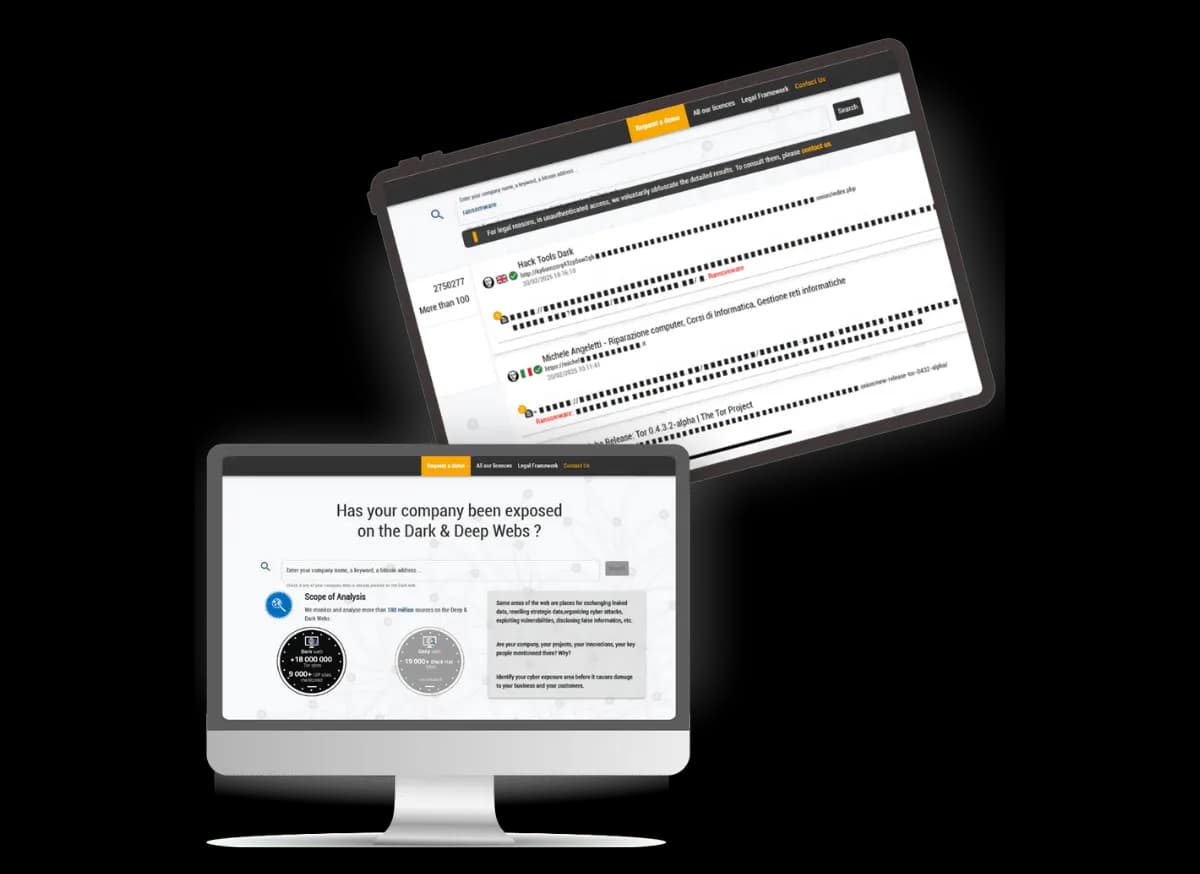
Faced with these constraints, companies turn to specialist providers able to audit their own OSINT exposure and put monitoring measures in place, or reduce their attack surface, while still having to consider the lawfulness of the solutions and services involved.
OSINT and cybersecurity: an underrated alliance
In cybersecurity, OSINT becomes a formidable preventive and defensive tool, within the legal framework. It notably makes it possible to:
- detect data leaks before they are exploited,
- spot fake profiles or identity theft,
- monitor threats on the dark web or on social networks.
According to IBM, the average cost of a data breach exceeds $4.45 million (IBM Cost of a Data Breach Report, 2023).
A company that is proactive about OSINT gains in responsiveness, in resilience and in visibility over its risks. It can also make sure its staff do not unwittingly become an attacker’s way in.
But this monitoring cannot be improvised. It requires:
- continuous watch,
- thorough knowledge of the sources,
- rigorous processing rules,
- a secure infrastructure,
- oversight by the organisation’s legal department.
Surrounding yourself with OSINT experts turns a threat into a strategic opportunity for your company.
Conclusion: why you (really) need an OSINT specialist
OSINT is not a simple Google search. It is a powerful analytical lever, but also a complex field, full of legal, technical and ethical traps.
A misread piece of data can cost a great deal. A piece of information left accessible can be used against you.
Whether the aim is to understand your digital exposure, anticipate risks, run security audits or protect your information assets, calling on a qualified OSINT provider is not a luxury but a necessity.
More and more organisations call on specialist firms to map their digital footprint, detect weak signals or secure their reputation. In a world where information circulates freely, only informed companies can protect themselves effectively. But first, and unavoidably: always check that the solutions and services are lawful and compliant with the legislation.
OSINT reveals far more than you think — provided you know where, and how, to look.