From the outset, the Tor network was meant to guarantee its users’ anonymity and get around censorship. It was therefore naturally suited to protecting political activity against regimes hostile to free speech. Today the network hosts a great many commercial and often illicit services; it nevertheless remains a sanctuary for campaigners and political activists of every stripe.
1. Anti-authoritarians
Unsurprisingly, we find a very strong presence of anti-authoritarian campaigning sites. Their political line fits the nature of the Tor network exactly. Most often these are Tor mirrors of clear web sites. That is notably the case for the French-language sites of this movement, each domain of which exists on the clear web with a .info extension and on Tor with a .onion one. These sites benefit from a technical mutual-aid network called MUTU.

MUTU network home page
The MUTU network relays publications from each of the sites spread across France and neighbouring countries, as the map below shows.

Territorial spread of anti-authoritarian sites
This political tendency is also well represented in Germany, with the Tor mirrors of Indymedia and its satellite Geistige Gefährdungen, which relays Indymedia’s publications alongside those of other German-language sites present only on Tor, such as Ompf.

Tor mirror of the German version of Indymedia

Site aggregating content from Indymedia and Ompf

Ompf
Within the same movement, Germany also has sites such as Kontrapolis and Schwartzlicht, likewise present on the clear web.
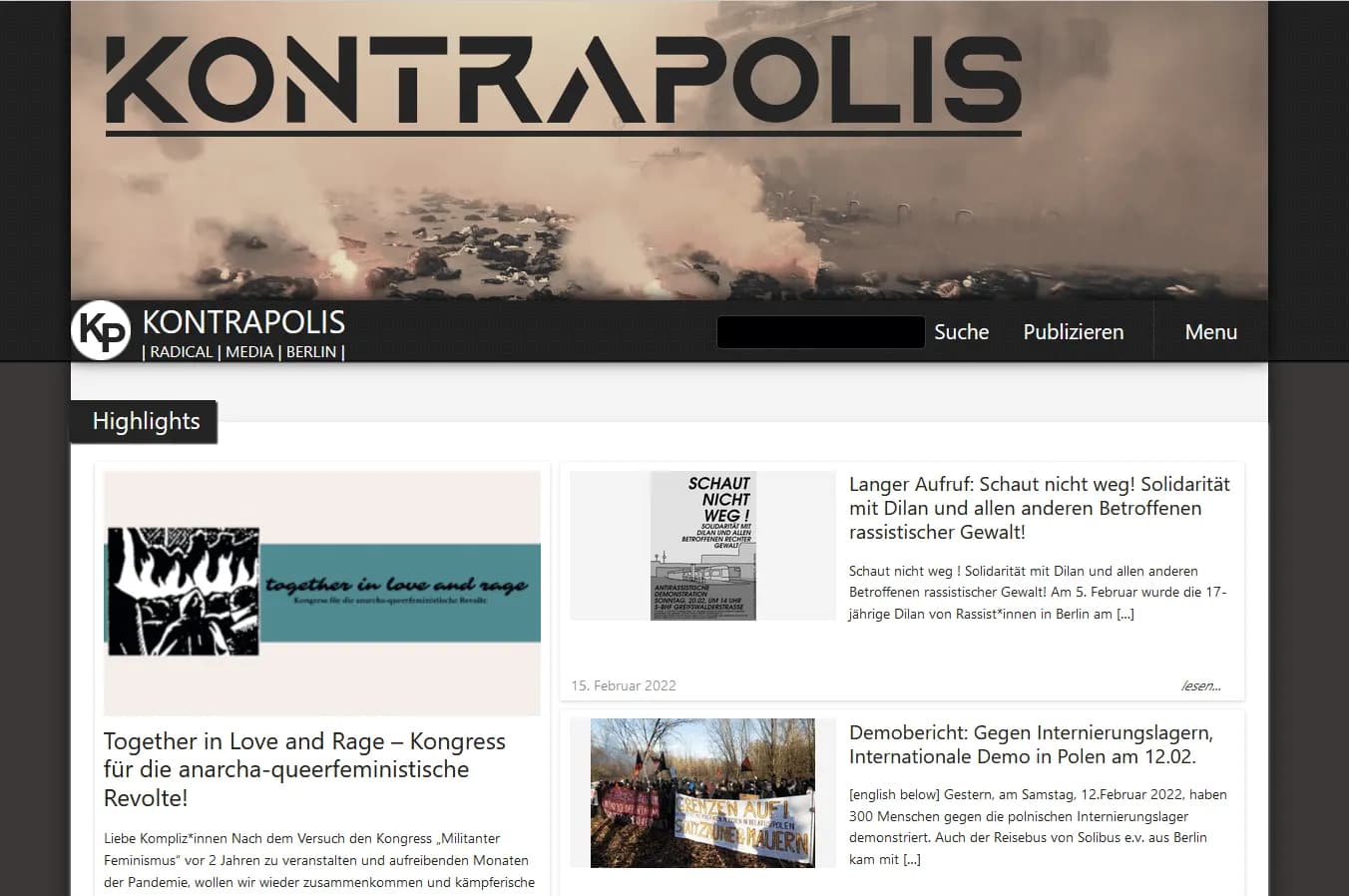
Kontrapolis home page

Schwartzlicht home page
Across the Atlantic, still within the anarchist, anti-capitalist and anti-colonial tendency, we find It’s Going Down, which is also the Tor mirror of a clear web site.
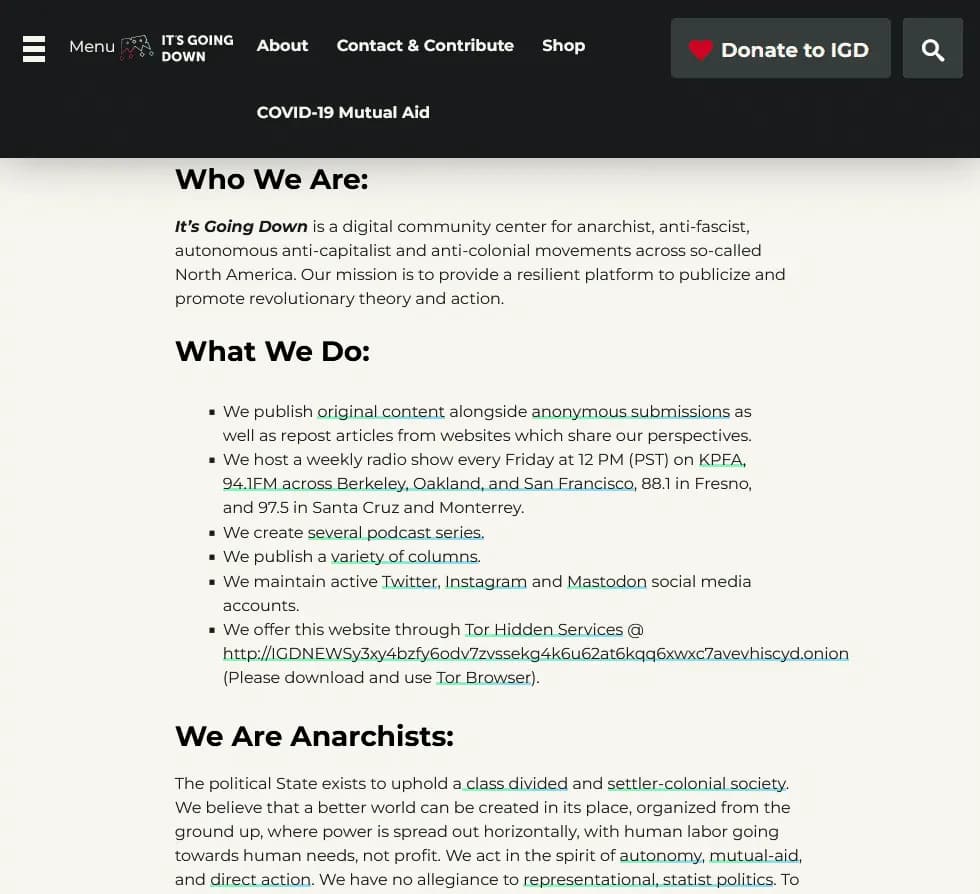
It’s Going Down site
2. White nationalism
At the other end of the political spectrum, the Tor network hosts a handful of sites tied to white nationalism, the best known being the American site The Daily Stormer. In its case we are dealing with a site originally created on the clear web which, having been banned by one host after another, fell back on the dark web.

The Daily Stormer home page
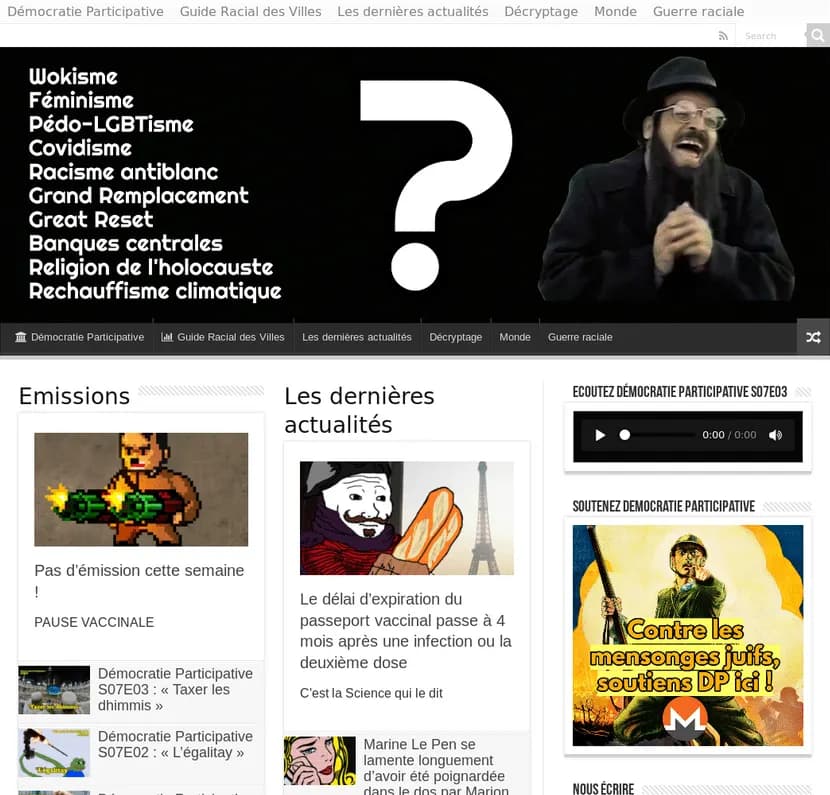
The deliberately extremist and abusive line of this site — whose name comes from the National Socialist newspaper Der Stürmer (1923–1945) — inspired the creation of the French site Démocratie Participative.

Démocratie Participative home page
The antisemitism of The Daily Stormer and Démocratie Participative finds an echo on the American site Heidenwut, whose aesthetic is rather surprising for a site of this movement. Alongside its longer articles, it offers a music section and a video game section, both heavily slanted — SS anthems, modified games.

Example article from Heidenwut

The ‘antisemitic haiku’ section

The ‘modified video games’ section
3. Activity of the moment
As we can see, the Tor network hosts campaigners from sharply opposed sides. It can also host political activity that is sensitive at a given moment. In 2017, for instance, the dark web saw the appearance of sites promoting Catalan independence, such as Tsunami Democràtic, since gone.
The Tor network can also host content far less likely to attract censorship, such as the site of a French Green MP reporting on her parliamentary work. François Asselineau’s UPR party also had an unofficial site on the dark web.

Tsunami Democràtic home page