Last August we began an inventory of the content found on the dark web. In the first part of this trilogy we covered certain types of site (forums, blogs, libraries, trading sites and news sites). Then, at the end of September, the second part of the trilogy appeared on our blog. It looked at code repositories and file hosting. This time we will cover:
Unlike browsing the clear web, finding your way around the Tor network is not guided from the moment the browser opens. Standard browsers ship with the main clear web search engines (Google, Bing, Yahoo and so on). Users can therefore search across ground that has already been cleared and signposted.
Tor Browser ships with DuckDuckGo. Ironically, DuckDuckGo does not index the Tor network; a search with it will return a certain number of results, but none from an Onion site.
So how can a user find their way around the Tor network?
Dark web search engines do exist, even if they are not bundled with Tor Browser, along with lists of Onion sites (Tor directories) that work as directories. To our knowledge the two oldest site lists are The Hidden Wiki and TorLinks (renamed OnionLinks). Both list a very small number of sites — about a hundred each. That is little next to the more than 110,000 active Onion domains detected by our search engine.
Dark web directories
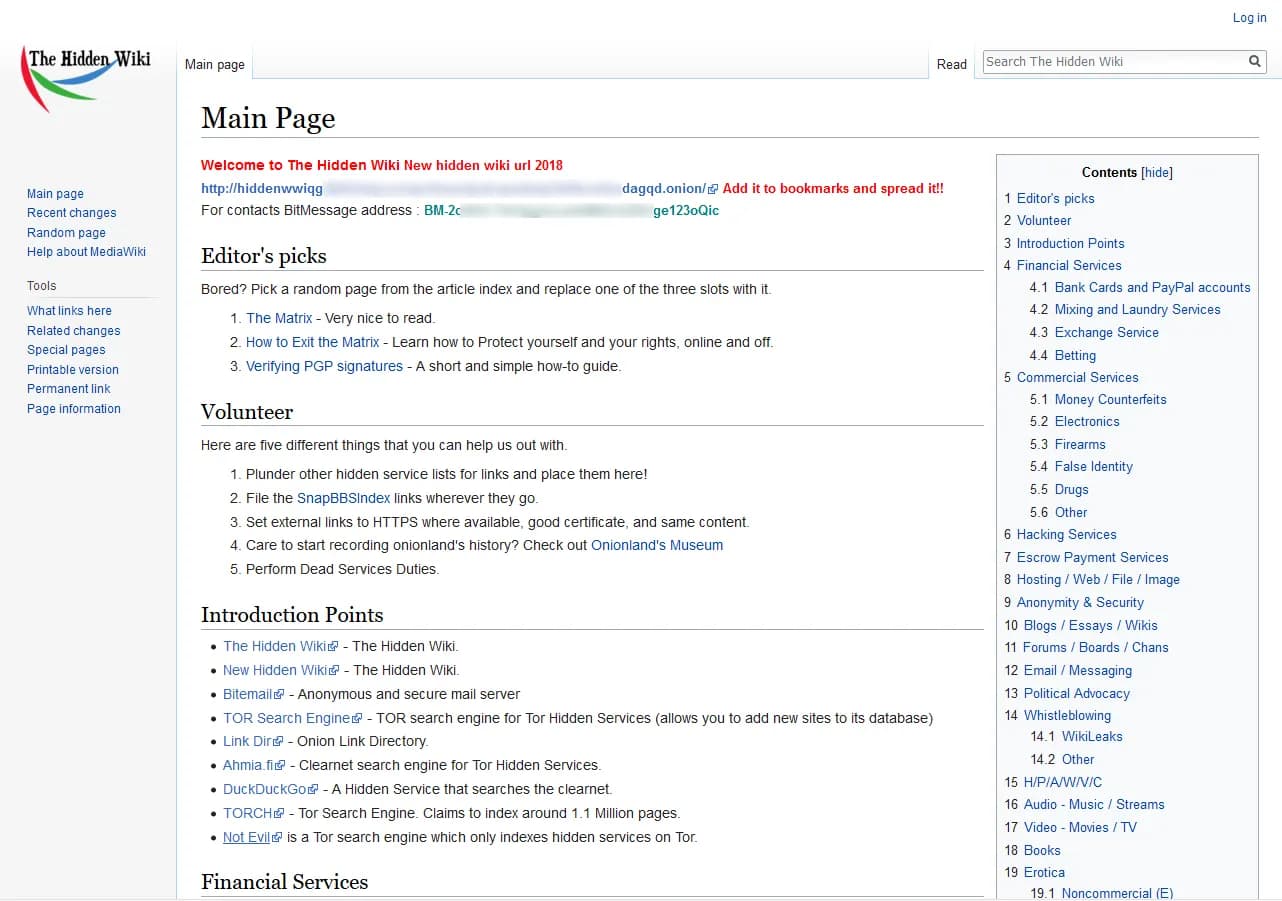
The Hidden Wiki.
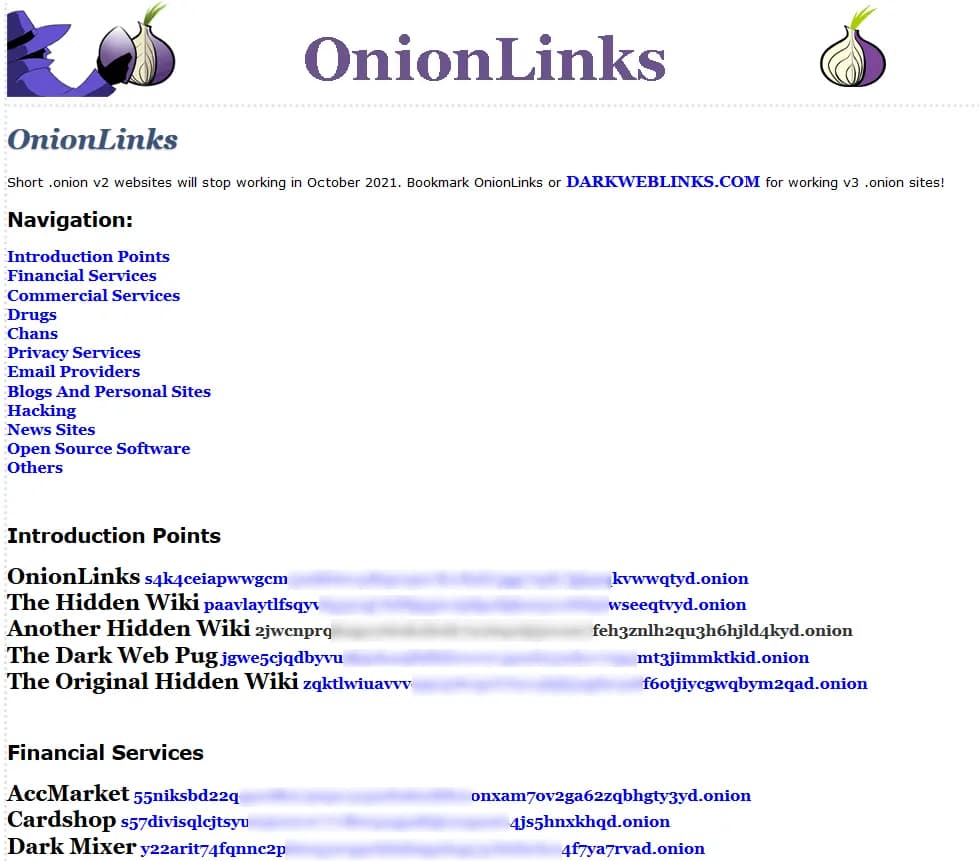
OnionLinks.
Some sections of the Hidden Wiki are entirely out of date, notably the list of French-language sites shown opposite. Several of the domains listed have been gone since 2019 (French Deep Web, Liberty’s Hackers).
Sillkitie, one of the two Finnish sites, was also taken down some time ago.

The Hidden Wiki’s list of French-language sites.
Some more recent directories, such as UnderDir, are more elaborate and catalogue several thousand domains.
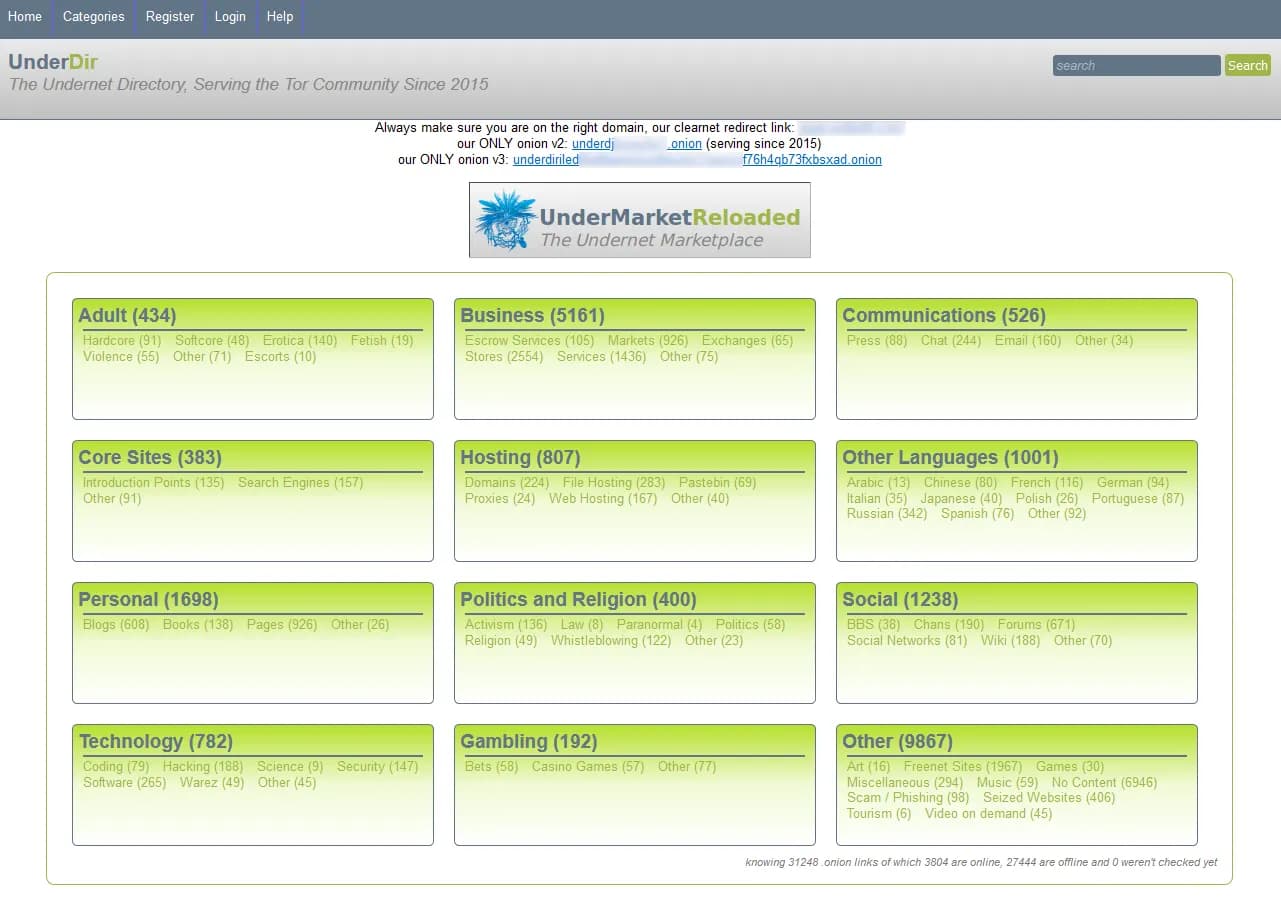
The UnderDir directory.
It is on directories like this one that the creators of decoy mirrors try to get their booby-trapped sites listed. A reporting mechanism has therefore been put in place so that the sites listed by UnderDir are neither scams nor child sexual abuse sites.
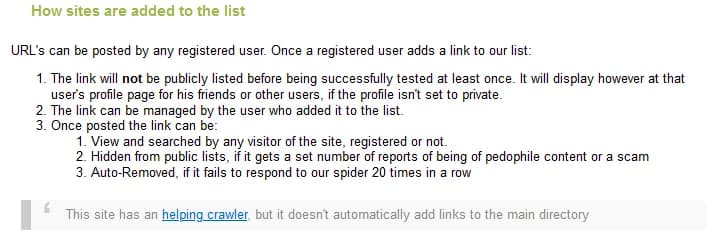
UnderDir add domain policy.
A search bar can be seen at the top right of the UnderDir home page (image opposite). We wanted to find out whether this search tool could answer a dark web user’s query satisfactorily.
Given the kind of activity found on this network, we opted for the query ‘ketamine’. We then ran that same query on several other dark web search engines.
We should acknowledge, though, that UnderDir’s primary purpose is to be, as its name suggests, a directory. The search bar is not the site’s main added value. Things are different for search engines proper.
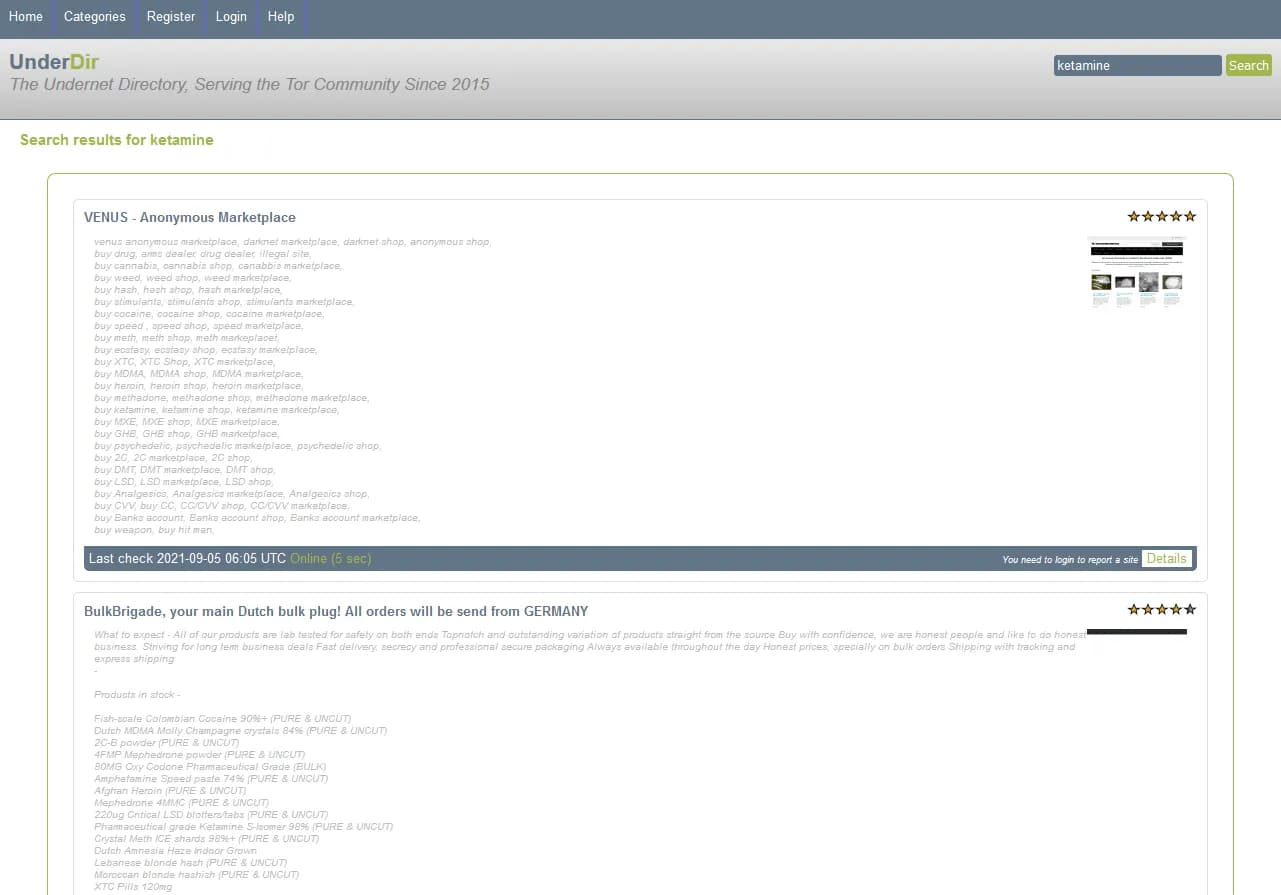
Results for the query ‘ketamine’ on UnderDir.
Dark web search engines
We selected seven of the best-regarded search engines on the Tor network and put the same ‘ketamine’ query to them. The results vary quite a bit, but are consistently disappointing in terms of the number of pages returned. Here are the figures for each engine, in alphabetical order.
Ahmia, the first search engine we tested, is the project of a Finnish researcher named Juha Nurmi. This engine (also reachable from the clear web) excludes child sexual abuse material. It also offers searching on the I2P network, which is fairly rare. Our ‘ketamine’ query returns 95 apparently relevant results.

The Ahmia search engine.
Unlike Ahmia, Hoodle appears to be funded by advertising for clandestine marketplaces, as most dark web engines are. Below the search bar we notice a top five of the most common queries. Two of them, ‘Topic Links’ and ‘LS magazine’, leave no doubt as to the content being sought (child sexual abuse material).

The Hoodle search engine.
Our query returns 100 results, which also seem fairly relevant.
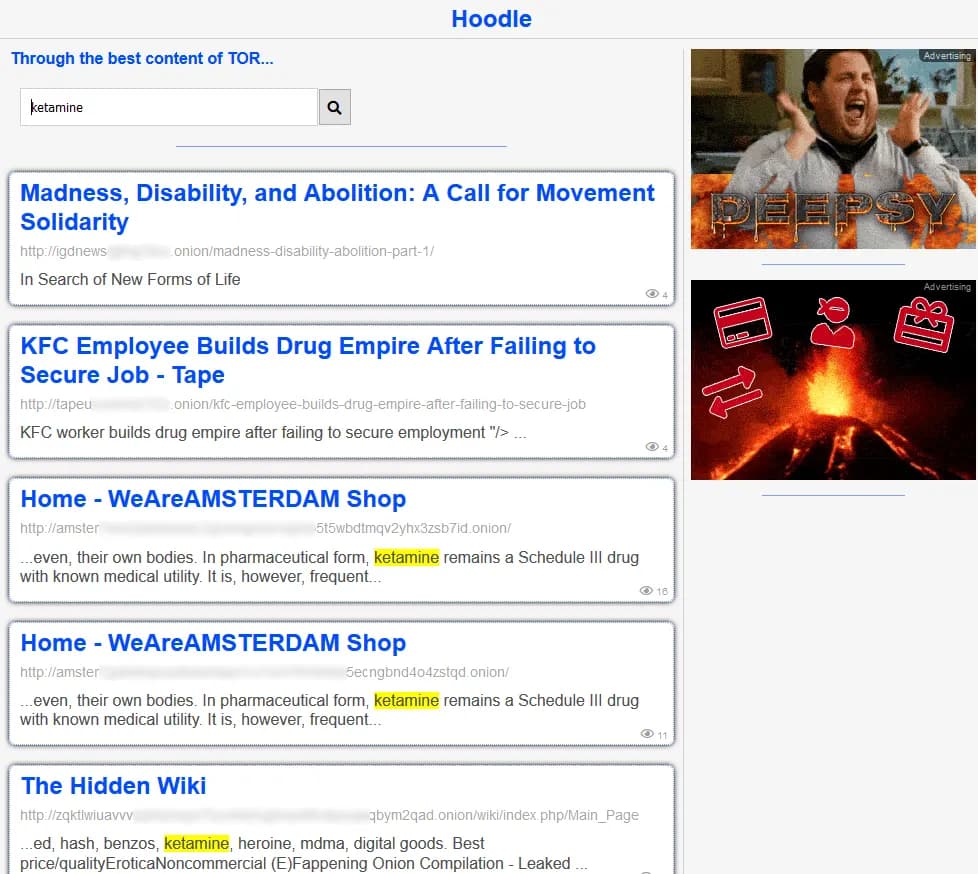
Results from the Hoodle search engine.
OnionLand Search likewise carries links sponsored by other dark web sites. Our query returns 167 results, the first of which are links to marketplaces. Like Ahmia, OnionLand Search offers searching on the I2P network. A ‘Most Popular Search Terms’ section again gives an idea of what users are looking for, without any real need to characterise it.

The OnionLand Search engine.
Tor66 is also sponsored by marketplaces. Beyond its standard search function, it offers random links (Random Onions) for the more curious — or the more reckless. The danger is somewhat lessened, though, since the engine displays the titles of the links. The user therefore has a more or less precise idea of the kind of random content they are about to open.

The Tor66 search engine.



Results for the query ‘ketamine’ on Tor66.
The ‘ketamine’ query returns 44 results. Those 44 results are not specific web pages but links to domains. The user is therefore taken to each site’s home page, and has to find the page that interests them inside each domain.
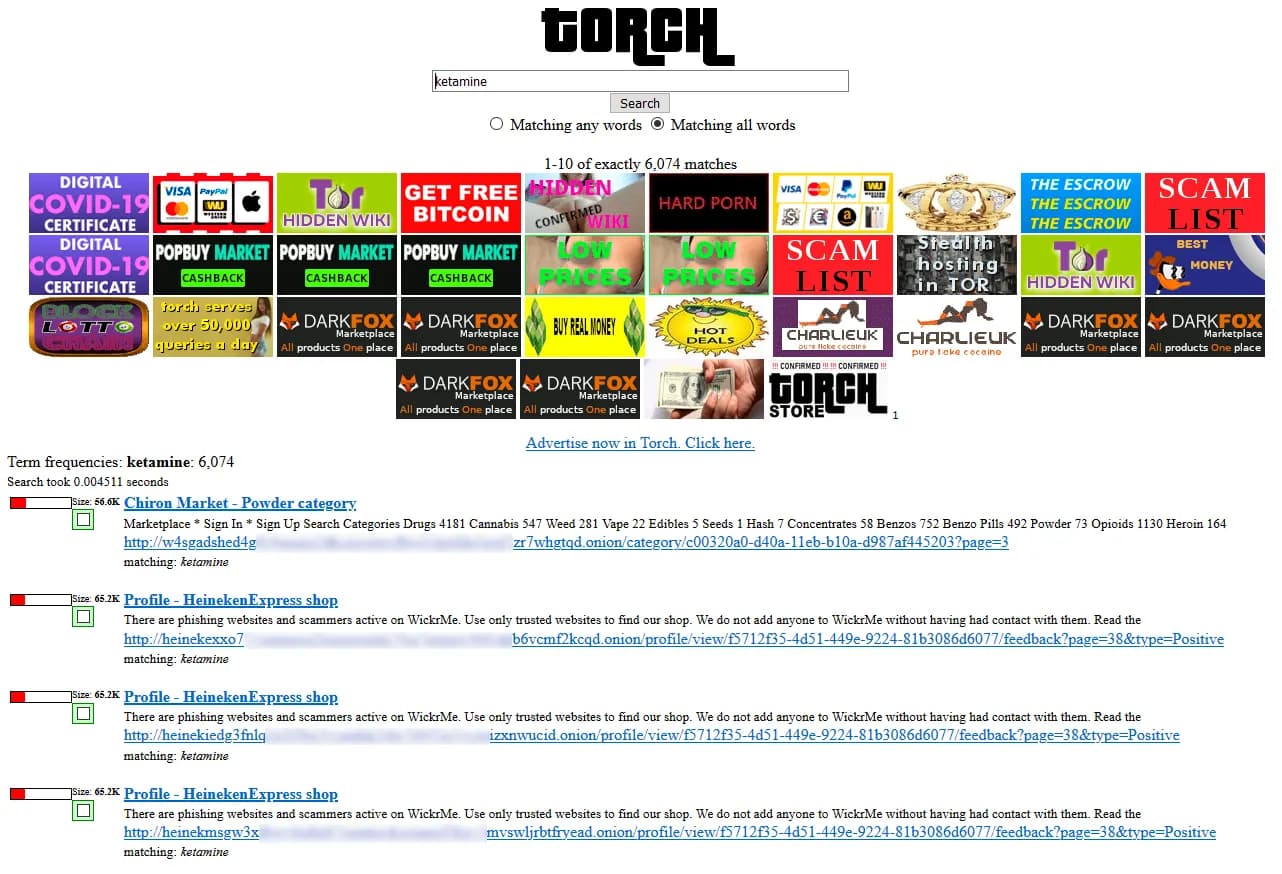
On the same model, Torch returns a very substantial number of results. It offers more than six thousand for our query — this time as precise URLs. So both in the number of results and in the quality of what is offered, Torch stands clearly ahead of the engines we tested, even if it is no match for a professional search engine.

The Torch search engine.
The TorDex search engine brings back a little over a thousand results, again giving precise URLs.

The Tordex search engine.
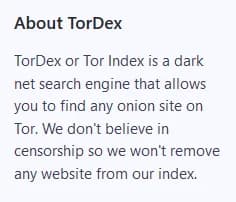
Unlike some search engines, TorDex’s creators openly claim that they do not filter content, which they describe as censorship.
Tor Search Engine is the last and probably the most disappointing of the engines we reviewed: on top of its rudimentary design, it gives us only two results.

The Tor Search Engine.
Tor network users therefore have no Google of the dark web, in the sense that no engine appears to index Onion sites exhaustively. Some of the engines tested here give interesting results, but well below what one might expect. Every user must therefore develop their own strategies for navigating the dark web without getting lost or opening content they would rather not have seen.
Our search engine is not on the dark web itself: it is a solution in its own right that indexes the dark web. Where our search engine brings back more than 143,000 dark web pages, UnderDir offers only two results.

The search bar of our Aleph Search Dark engine
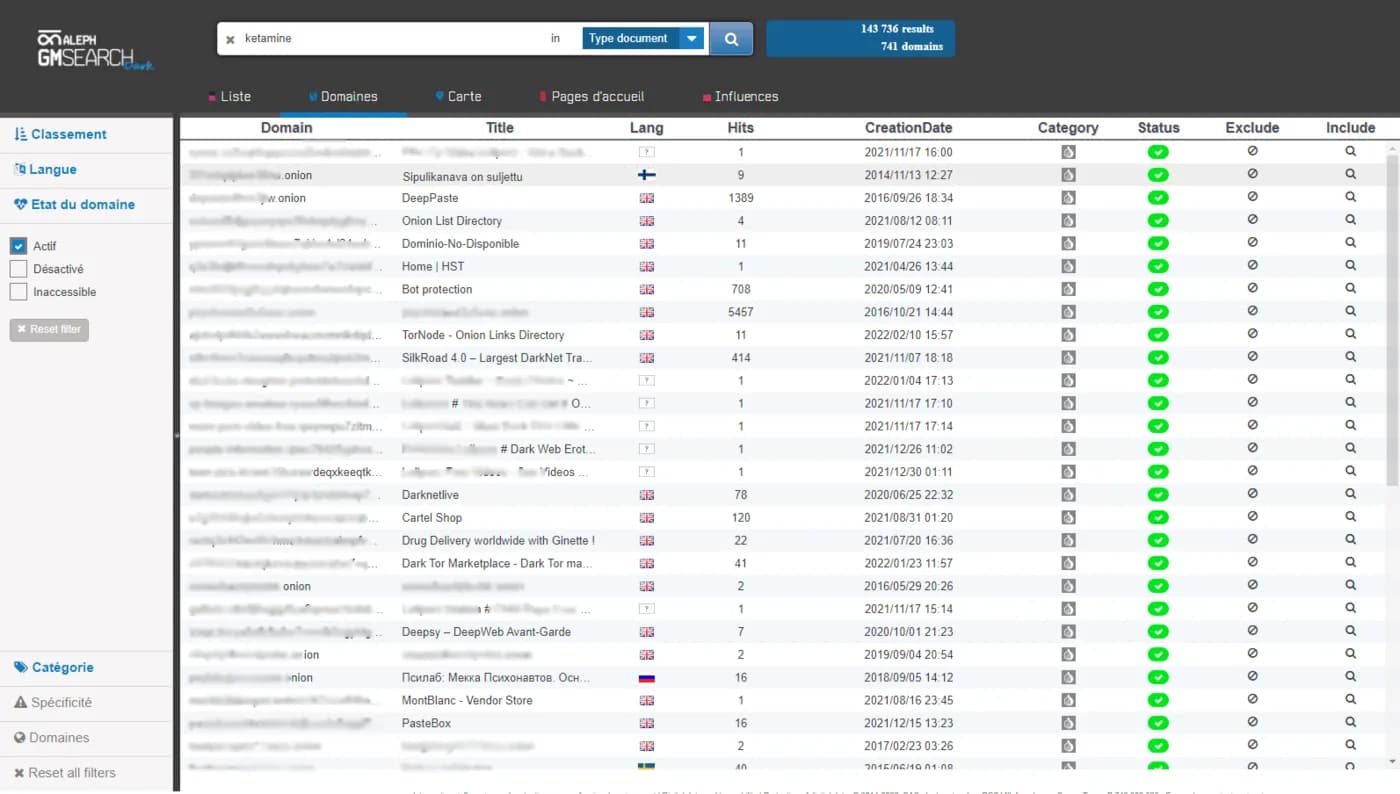
Results shown as a list of domains
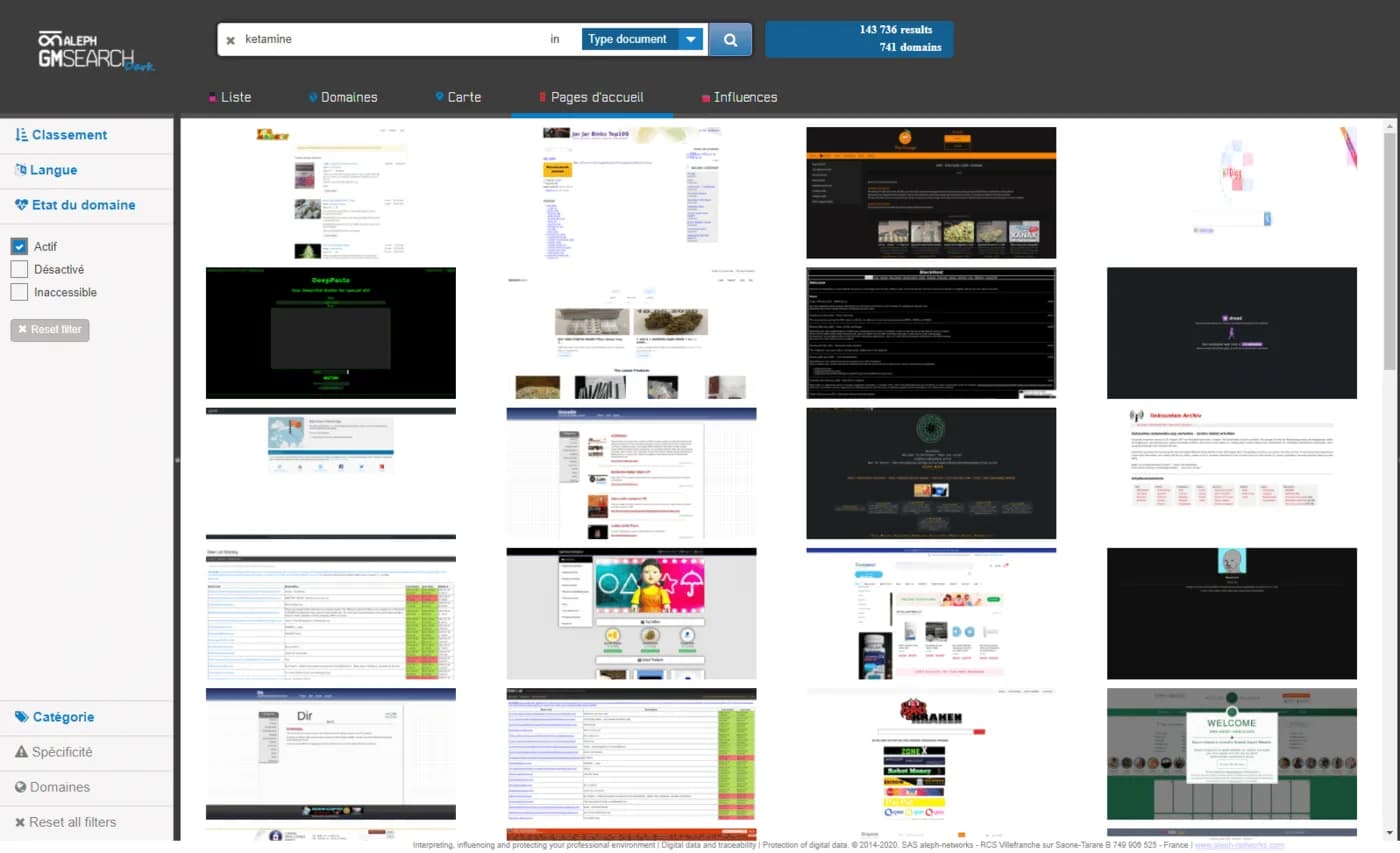
Results shown as images of the home pages.